
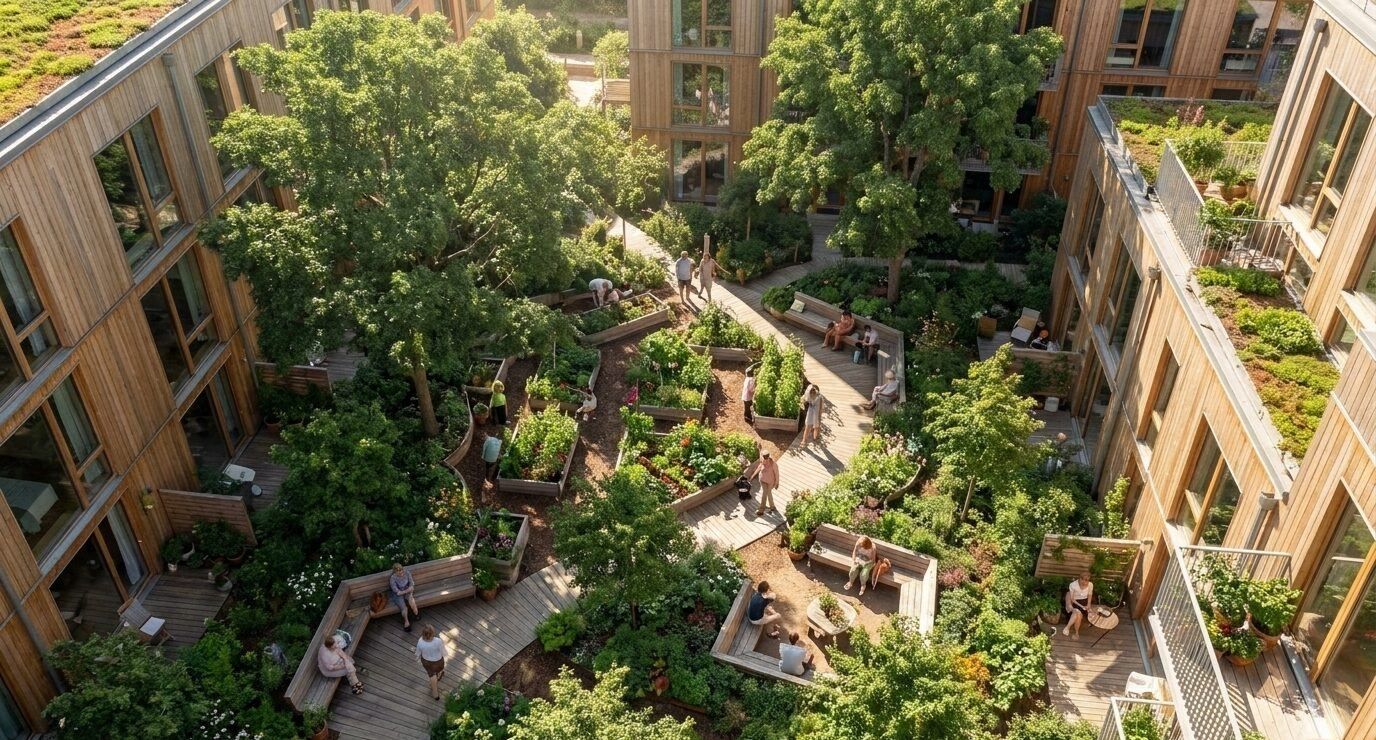
Now City Homes · Business plan · November 2026
West Coast apartments and townhomes from factories, and the orders that keep the factories running.
The West Coast permits about 79,000 apartments and townhomes a year and needs far more. We sign up the buyers first. Then partner factories along I-5 build one catalog for all of them.
Problem
Apartments cost too much to build, and housing factories keep closing.
Projects stop at the spreadsheet
- A 6-story apartment building in Portland cost $422,662 a home in 2023, land and fees included. Its hard cost alone was $243,211 a home, $350 a square foot.[1] Seattle mid-rise hard costs reached $410 to $428 a square foot in 2024.[2]
- Seattle's own evaluation found most projects would not pencil even if its affordable-housing fee were removed entirely.[2]
- San Francisco has about 58,400 homes approved but not under construction.[3] Seattle permitted fewer than 2,000 homes in 2025, down from 17,400 in 2020.[4]
- The three states' own targets call for about 391,000 homes a year. They permitted 153,608 in 2025, a gap of about 238,000.[5][6][7][8]
Factories die between orders
- Katerra went bankrupt in 2021.[9] Veev shut down in 2023.[10] California's flagship modular plant, Factory_OS, closed in 2026 and its equipment was sold.[11]
- Prescient, the closest US match to a panelized steel system, closed its Colorado plant in 2023.[12]
- After 65 interviews, the Terner Center found California's binding constraint is unstable demand, not factory capacity.[13]
- Each developer buys one building at a time. No factory can plan a production line around that.
Solution
One catalog. One order book. Factories built on the order book.
Now City Homes becomes the anchor buyer the West Coast lacks. We gather developers, cities, agencies and universities into ten-year commitments for one catalog of buildings, and partner factories open against those commitments.
We own the demand, not the factory
The factory is a partner's capital. The order book, the catalog and the buyer relationships are ours. That is the opposite of Katerra, which built everything at once before any of it worked.
Panels, not boxes
Flat panels ship at legal width on ordinary trucks and rail cars. Whole modules need permits and, in California, police escorts.[13] A panel plant also costs far less to build than a module plant.[14]
The Now City stack on every building
The same designs repeat, so energy, daylight, cost and schedule data from each building improve the next. Passive House-level envelopes are engineered once and carried into every building.
Why now
The laws changed in the last eighteen months, and the land is already there.
Market
About 79,000 apartments and townhomes are permitted a year. Three factories need under 10% of them.
We counted every apartment and townhome permitted in California, Oregon and Washington: the kinds of homes the catalog makes, before any of the unmet need. The count includes high-rise buildings taller than anything in the catalog; Census cannot separate them.
2025 was the low point of the cycle: permits for 5+ unit buildings averaged 73,366 a year from 2019 to 2025, and January to September 2026 ran 26% ahead of 2025. Using 2025 keeps the count conservative. The full demand audit, by state and metro, is on the Market research page.
Product
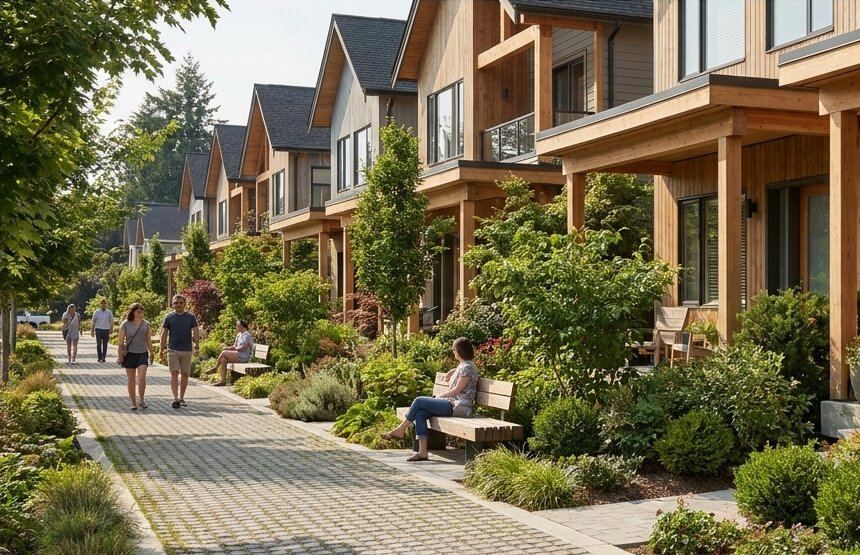
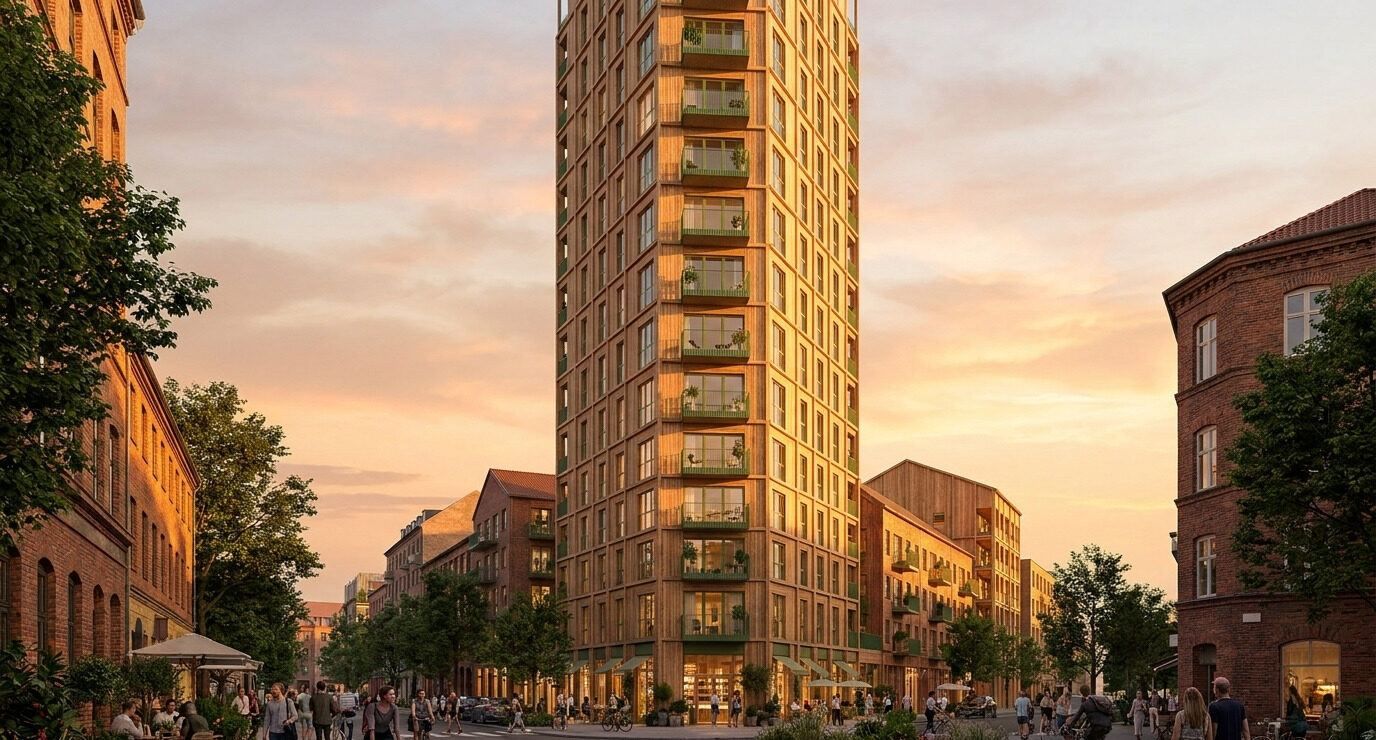
One frame, four kinds of home, every one made from the same parts.
The catalog shares one structure, one set of building systems and one way of being made. The outside of each building is designed for its street.
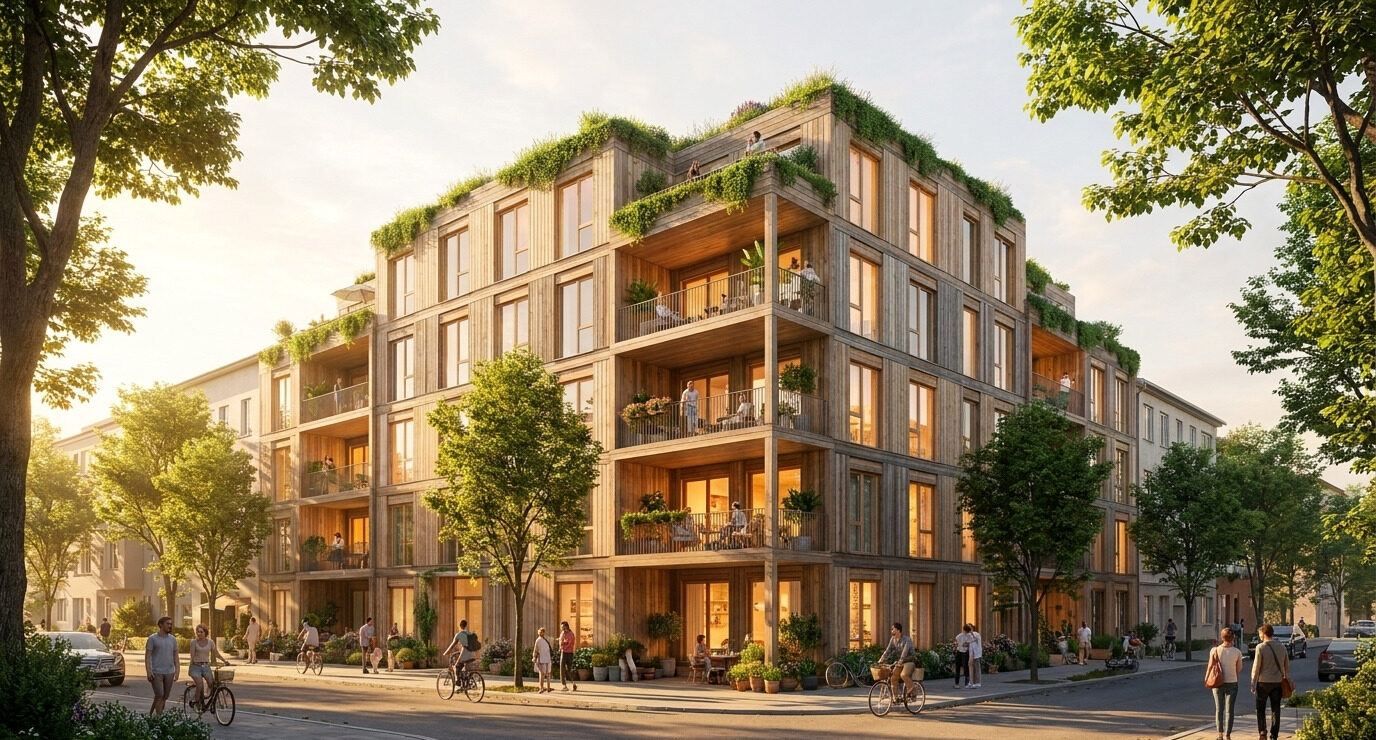
The hero product
The Now City Block
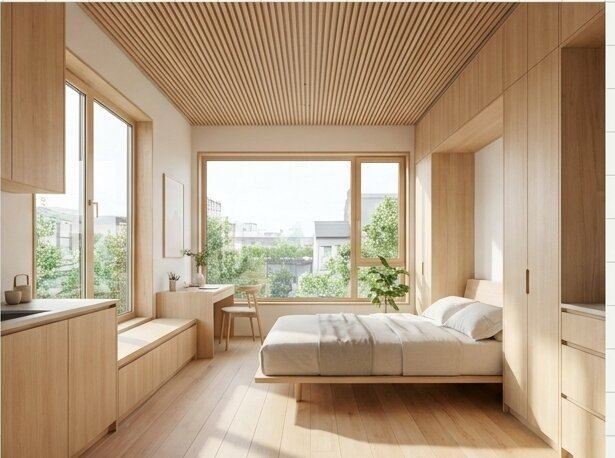
A 4 to 6 story building around one shared stair, so most homes have windows on two sides. The same shell holds studios, family homes of three or four bedrooms, or a mix. Blocks stand alone or join around a courtyard.
With no long corridor, more of each floor is home, and the plan repeats from building to building, which is what a factory needs.
Cost
The plan needs a complete building for $280 a square foot. The $150 steel quote has to prove it.
An international supplier has quoted a cold-formed steel building system at about $150 a square foot. What that price covers decides almost everything in this plan, so we model it three ways.
What the evidence says
RLB's 2026 range for multifamily hard cost starts at $270 a square foot in Los Angeles, $290 in Seattle and $350 in Portland.[25] $150 for a finished building would be 44% to 64% below the cheapest of them. The closest US case, a steel module maker building in China, claims about 30% savings (company-reported).[26]
What $150 probably buys
A bare light-steel frame lists at about $7 to $28 a square foot before shipping, so $150 almost certainly includes walls, floors, roof and envelope, and perhaps installation. Foundations, site work, plumbing, electrical, finishes and the contractor's fee are probably extra. We need the supplier's scope in writing.
Tariffs
Since April 2026, steel tariffs are charged on the full customs value: 25% for listed prefabricated steel buildings and 50% for articles made almost wholly of steel.[27] A customs broker has to classify the system before any landed price is real.
Why 20% is enough: Portland's own study found 6-story projects become feasible if hard costs fall 15 to 40%.[1] The plan uses 20%. If the supplier's price does cover the whole building, the saving is about 46% with a 25% tariff, and less with a 50% tariff and ocean freight. That helps buyers more than it helps us: see the business model.
Business model
Buyers save about $48K a home. We earn about $5.8K of it.
Now City Homes charges a program fee on every building delivered through the catalog. In the plan the fee is 3% of the building contract. A share of the buyer's saving is the alternative we will test.
One courtyard block
96 homes: $18.6M instead of $23.3M
At the Portland prototype's cost per home, the buyer saves $4.6M in hard cost. Our fee is $560K. Every figure here is our assumption, and the fee is the thing buyers will tell us about first.
Two ways to charge
| Structure | Per home | Who it suits |
|---|---|---|
| 3% of the contract (plan) | $5.8K | Developers who budget fees as a share of cost |
| 15% of the saving | $7.2K | Public buyers who pay only for proven savings |
A contract fee earns less as buildings get cheaper. If the $150 quote turned out to cover the whole building, buyers would save $111K a home, and our ten-year revenue would fall from $228M to $154M. A share of the saving would rise instead. That trade is the main question for the first buyer conversations.
Factories and freight
Three panel plants put every big West Coast metro within about 250 road miles.
Each plant sits a short drive from a West Coast port for the imported system in the early years: Tacoma, Stockton, and Los Angeles and Long Beach. Each needs 20,000 homes over ten years: 2,000 a year at full output, our assumption. That is about 4% of the I-5 market each year.
Year 3 · Pacific Northwest
Tacoma or Salem
Tacoma is 33 miles from Seattle and Salem 47 from Portland.[28] It ships to Washington, which already allows six-story single-stair buildings, and to Oregon, which allows four.
Year 4 · Northern California
Stockton or Sacramento
Stockton is 72 miles from Oakland, with rail and a deepwater port. It serves the Bay Area, Sacramento and the CA-99 cities.
Year 5 · Southern California
Inland Empire
Ontario is 37 miles from Los Angeles. It serves Los Angeles, Riverside and San Diego, which together permitted 25,251 homes in 5+ unit buildings in 2025.[23]
The plan assumes ordinary trucks and rail. Autonomous electric freight would lower delivery cost later, but nothing in the numbers depends on it.
Competition
US factory builders closed between orders. Sweden's catalog program, on multi-year orders, built about 10,000 apartments.
| Who | Model | What happened |
|---|---|---|
| Katerra | Design, factories and contracting at once | Bankrupt 2021[9] |
| Veev | Steel-panel modules | Shut down 2023[10] |
| Factory_OS (Harbinger) | Modules, California | Closed 2026, equipment sold[11] |
| Prescient | Panelized cold-formed steel | Colorado plant closed 2023[12] |
| Ilke Homes (UK) | Modules on a non-binding order book | Administration 2023[31] |
| Kombohus (Sweden) | Public buyers order from a catalog on multi-year frameworks | About 9,500 to 11,000 apartments built[32] |
We are not a factory
Every failure above carried a factory's fixed cost through a gap in orders. We carry a team.
Others are circling the same idea
Terner's March 2026 report to the California Assembly names demand aggregation as a policy theme, with regional housing finance agencies and universities as buyers.[13] We intend to be the private catalog they can buy from.
Our edge is the whole district
Now City plans neighborhoods, not single buildings, and runs them after. That gives us our own first orders and the operating data that improves each building.
Team
Now City's two co-founders, roughly equal owners, and four first hires.
Co-founder and CEO
Erik Gillberg
Product, catalog, go-to-market strategy and marketing. 30 years in property operations and 20 in technology and startup leadership.
Co-founder and COO
Ritchie Ju
Sales and account management. Trained in architecture and urban design at Carnegie Mellon and Columbia; supported the capital raise for a 1,000-home project in New York.
Senior advisors
Neal Payton and Michael H. Shuman
Neal leads the western US urban design practice at Torti Gallas. Michael is an economist and attorney who works on local capital.
First hires
Supply, engineering, sales
A manufacturing and supply lead, a structural and code engineer for steel and single-stair approvals, and two account executives.
Financials
$35M a year by year 6. Cash break-even in year 5.
Revenue follows the factories. Year 1 builds the catalog and the order book. Year 2 delivers 200 pilot homes from the imported system. Factories open in years 3, 4 and 5.
| Case | Homes, 10 years | Revenue, year 10 | Peak cash | Break-even |
|---|---|---|---|---|
| Low: 15% saving, 2% fee, 1,500 homes a plant, first plant in year 4, then one every two years | 20,450 | $18.6M | $18.5M | None |
| Plan | 39,200 | $35M | $8.9M | Year 5 |
| High: 30% saving, 4% fee, 2,500 homes a plant | 48,950 | $51M | $7.6M | Year 4 |
| $150 quote covers the whole building (about 46% saving with a 25% tariff, 3% fee) | 39,200 | $23.6M | $11.2M | Year 6 |
Factories are partners' capital and do not appear in our costs. Our costs are the team, $1.5M of catalog development in each of years 1 and 2, and $2K a home for quality checks, delivery coordination and a warranty reserve. All drivers on this page are our assumptions; the market figures above are sourced.
Go to market
Sign 20,000 homes of letters of intent before the first factory opens.
Ritchie leads sales. The first factory needs ten years of volume, and the first three years of it should be in framework agreements with deposits before the partner builds. Ilke Homes in the UK claimed a £1 billion order book and still went into administration in 2023, because none of it was binding.[31]
| Where the orders come from | Scale of the opportunity | How we reach them |
|---|---|---|
| Our own first district | A mixed-use masterplan in the Pacific Northwest; first homes scheduled for 2029 | Now City is the master developer. No sales cycle. |
| City and state surplus land | California's excess state land program has more than 5,100 homes in development on 38 projects[33] | Answer surplus land offers with a catalog price and schedule attached |
| Stalled, approved projects | About 58,400 approved homes not started in San Francisco alone[3] | Re-price approved projects on the catalog with their developers |
| Transit agency land | Up to about 240,000 homes on land California transit agencies own; 41% of the parcels fall in SB 79 zones[18] | Framework agreements with agencies that run joint development programs |
| Malls and office parks | Six West Coast mall projects plan about 15,400 homes[34] | Owners and master developers who need many buildings on one site |
| Universities | UC reports 9,000 shovel-ready student beds without funding[35] | A small-home variant of the Block, priced for campus budgets |
| Commercial corridors | 1.6 to 2.4 million homes of capacity on California commercial land opened by AB 2011[36] | Developers using by-right approval, who want speed most |
| Mapped on-market sites | Partnerships in discussion to map every on-market site that fits the catalog | Bring a priced building to the owner of each fitting site |
| Master-planned communities | California Forever projects about 175,000 homes over 40 years (developer's figure)[37] | A long option on volume. Not counted in the order book. |
Has to be true · 1
A complete building for $280 a square foot
Proved on the pilot buildings in year 2, with the supplier's scope, the tariff and site work all priced.
Has to be true · 2
20,000 homes of commitments per factory
Letters of intent first, then framework agreements with deposits. Sweden's Kombohus program ran on six-year frameworks with indexation.[32]
Has to be true · 3
A factory partner who builds on our order book
Green steel shows the pattern: Stegra financed its plant with about 60% of output under binding offtake contracts.[38]
The ask
$8.9M to reach cash break-even, and letters of intent for 20,000 homes.
Investors
$8.9M in the plan
It funds catalog engineering and approvals, the pilot and the sales team until fees cover costs in year 5. The low case needs $18.5M and does not break even in ten years.
Buyers
A letter of intent
Name the sites, the number of homes and the years. We price the buildings from the catalog and turn the letter into a framework agreement once the pilot proves the cost.
Factory partners
Capacity on our order book
Reserve output for our catalog at an indexed price per square foot, and build the plant when the first three years are committed.
| When | Milestone |
|---|---|
| Year 1 (2027) | Supplier scope and landed price in writing; catalog designed for Washington, Oregon and California code; letters of intent for 20,000 homes; factory partner term sheet |
| Year 2 (2028) | 200 pilot homes delivered from the imported system at a measured cost; first framework agreements with deposits; first plant financed |
| Year 3 (2029) | Pacific Northwest plant opens; 1,000 homes |
| Year 4 to 5 | Northern and Southern California plants open; 5,000 homes in year 5 |
| Year 6 on | 6,000 homes a year from three plants |
Detail
Risks, open questions and sources.
Risks and how we would know
- The $150 price covers less than we hope. If a complete building cannot reach $280 a square foot on the pilot, the plan stops at the pilot.
- Steel in seismic zones. US load-bearing cold-formed steel at 4 to 6 stories is mostly outside seismic regions, and a 6-story building generally needs rated construction or a podium. The structural engineer is the first hire for this reason.
- Tariffs. A 25% or 50% duty on an imported system changes the price. A customs ruling comes before any buyer sees a price.
- Letters of intent do not bind. Ilke's order book did not save it. Deposits and framework agreements are the test, not letters.
- California single-stair. Without a statewide change, California buildings use today's two-stair code and lose part of the efficiency.
- Frame material. The catalog on nowcity.co uses mass timber; this plan prices a cold-formed steel system. Year 1 prices both against the same complete-building scope before the pilot.
What we assumed, and why
| Assumption | Plan | Basis |
|---|---|---|
| Hard cost today | $350/sf | Portland 6-story prototype (BAE 2023) and the low end of RLB's 2026 Portland range. Seattle and Sacramento were higher in the same study. |
| Saving for a complete building | 20% | Our target. Portland's study found 15 to 40% makes 6-story projects feasible. |
| Building area per home | 694 sq ft | The Portland prototype's hard cost, $243,211 a home, divided by $350 a square foot. Larger homes would raise both the saving and the fee. |
| Catalog development | $1.5M in each of years 1 and 2 | Engineering for three states' codes, seismic approval of the steel system, a customs ruling and pilot design; our assumption |
| Fee | 3% of contract | Our assumption, to test with buyers |
| Factory output | 2,000 homes a year | Half of one builder's company-reported panel plant figure |
| Our cost per home | $2K | Our assumption |
| Team | $5M a year at full scale | Founders, supply lead, engineer, account executives, catalog and delivery staff; our assumption |
Sources
- BAE Urban Economics for the City of Portland, Inclusionary Housing Calibration Findings, July 2023. https://www.sightline.org/wp-content/uploads/2023/08/Portland-Inclusionary-Housing-Revised-Calibration-Findings-7-7-2023-1.pdf
- BERK Consulting and Heartland for the City of Seattle, Mandatory Housing Affordability Five Year Evaluation, March 2025. https://seattle.gov/documents/Departments/OPCD/SeattlePlan/MHA5YearEvaluationBERK2025.pdf
- San Francisco Planning, Housing Production Development Pipeline, 2026 Q2. https://sfplanning.org/sites/default/files/documents/reports/Housing_Production_Development_Pipeline-2026Q2.pdf
- The Urbanist, "MHA housing accelerator proposal hits Seattle process snag", July 2026. https://www.theurbanist.org/2026/07/03/mha-housing-accelerator-proposal-hits-seattle-process-snag/
- US Census Bureau, Building Permits Survey, state annual files 2019 to 2025 and January to September 2026. https://www.census.gov/construction/bps/
- California HCD, Statewide Housing Plan (2022): about 2.5 million homes over the sixth housing cycle, as reported by CalMatters, August 2026. https://calmatters.org/housing/2026/08/california-rhna-housing-affordable-progress/
- Washington Department of Commerce, "Washington state will need more than 1 million homes in next 20 years", March 2023. https://www.commerce.wa.gov/washington-state-will-need-more-than-1-million-homes-in-next-20-years/
- Oregon Office of Economic Analysis, Oregon Housing Needs Analysis 2026 production targets, December 2025. https://www.oregon.gov/das/oea/Documents/OHNA-2026-Results-Report.pdf
- ProBuilder, 2021, on Katerra's bankruptcy and the sale of its Tracy plant. https://probuilder.com/modular-builder-vbc-verge-25-million-buy-katerra-assets
- TechCrunch, "Prefab home builder Veev reportedly shutting down", November 2023. https://techcrunch.com/2023/11/27/prefab-home-builder-veev-reportedly-shutting-down-after-reaching-unicorn-status-last-year
- Vallejo Sun, February 2026, and Offsite Innovators, "Farewell to Harbinger", September 2026, on the closure of Factory_OS (renamed Harbinger). https://offsiteinnovators.com/farewell-to-harbinger-a-factory-that-proved-modular-could-build-at-scale/
- ChemAnalyst, September 2023, on the closure of Prescient's Arvada, Colorado cold-formed steel plant. https://www.chemanalyst.com/NewsAndDeals/NewsDetails/prescient-a-leading-colorado-construction-tech-firm-announces-closure-of-arvada-19493
- Terner Center for Housing Innovation, "Potential Pathways to Scale Innovative Construction Methods in California", March 2026. https://ternercenter.berkeley.edu/research-and-policy/potential-pathways-to-scale-innovative-construction-methods-in-california/
- Builder, "Clayton to bridge off-site site-build gap with new $14 million Tennessee factory", 2019 (company-reported capacity). https://builderonline.com/builder-100/strategy/clayton-to-bridge-off-site-site-build-gap-with-new-14-million-tennessee-factory_o
- California HCD, "SB 79 Transit-Oriented Development", updated August 2026. https://www.hcd.ca.gov/planning-and-research/sb79-tod
- Futurewise, "HB 1491 FAQ" (Washington transit-oriented development, 2025). https://futurewise.org/tod1491/
- Washington RCW 19.27.115 and WSR 25-23-081; Oregon Building Codes Division, 2025 OSSC Appendix Q (single-exit stair). https://www.oregon.gov/bcd/codes-stand/Documents/25ossc-single-exit-stair-appq.pdf
- Enterprise Community Partners, "Assessing the Potential of Transit Agency-Owned Land for Housing Development in California", March 2026. https://enterprisecommunity.org/sites/default/files/2026-03/Enterprise-Transit-Agency-Land-Use-Report.pdf
- Office vacancy, Q3 2026: CBRE San Francisco, CBRE Portland, Kidder Mathews Seattle and San Diego, TenantBase Los Angeles. https://www.cbre.com/insights/figures/san-francisco-office-figures-q3-2026
- Novogradac, California AB 2185 enacted, September 2026. https://www.novoco.com/public-media/documents/california-ab-2185-enacted-09292026.pdf
- Oregon Housing and Community Services, Modular Housing Development Fund ($20M, from HB 2001, 2023). https://www.oregon.gov/ohcs/development/pages/modular-housing-development-fund.aspx
- US Census Bureau, Survey of Construction microdata 2019 to 2025 (our tabulation of attached homes, Pacific division). https://www.census.gov/construction/chars/microdata.html
- US Census Bureau, Building Permits Survey, metro (CBSA) annual files 2024 and 2025. https://www2.census.gov/econ/bps/CBSA%20(beginning%20Jan%202024)/
- US Census Bureau, Characteristics of New Housing, multifamily tables, 2025. https://www.census.gov/construction/chars/current.html
- Rider Levett Bucknall, North America Quarterly Cost Report, Q2 2026, indicative construction costs. https://www.rlb.com/wp-content/uploads/sites/4/2026/06/Q2-2026-QCR_7.7.2026.pdf
- Bisnow Studio B (sponsored), "2025 will be modular's year in LA", Stack Modular (company-reported). https://www.bisnow.com/studio-b/los-angeles/multifamily/los-angeles-multifamily-stack-modular-studiob-2025-will-be-modulars-year-in-la-127548
- Sandler, Travis & Rosenberg, Section 232 tariffs on steel and aluminum (tracker through August 2026); Arent Fox Schiff, April 2026. https://www.strtrade.com/trade-news-resources/tariff-actions-resources/section-232-tariffs-on-steel-aluminum
- OSRM routing on OpenStreetMap data, road distances between city centers, queried November 4, 2026. https://router.project-osrm.org/
- Automotive World, "California grants Kodiak AI autonomous trucking permit", August 2026. https://www.automotiveworld.com/news/california-grants-kodiak-ai-autonomous-trucking-permit/
- FreightWaves, "FRA approves first autonomous railcar test program" (Parallel Systems). https://www.freightwaves.com/news/fra-approves-first-autonomous-railcar-test-program
- Construction Enquirer, "Offsite specialist Ilke Homes falls into administration", June 2023. https://www.constructionenquirer.com/2023/06/30/offsite-specialist-ilke-homes-falls-into-administration/
- Sveriges Allmännytta, "Public housing: Sweden's Kombohus"; Unihouse on the 2020 six-year framework. https://sverigesallmannytta.se/in-english/public-housing-swedens-kombohus
- California Department of General Services, "California Closes 2025 with Affordable Housing Wins", December 2025 (excess state land program). https://www.dgs.ca.gov/Press-Releases/Page-Content/News-List-Folder/California-Closes-2025-with-Affordable-Housing-Wins
- Mall redevelopment plans: Stonestown (CBS News SF, July 2024), The Rise at Vallco (SV@Home, February 2026), Westminster (CoStar), Lloyd Center (Axios Portland, February 2026), Northgate (The Urbanist, 2024), Tanforan (CEQAnet SCH 2023120409). https://cbsnews.com/sanfrancisco/news/sf-stonestown-galleria-3500-new-homes-final-approval-board-of-supervisors
- University of California, Student Housing Projects 2026 fact sheet. https://housingbond.universityofcalifornia.edu/_files/uc-student-housing-projects-2026-r6-acc.pdf
- UrbanFootprint, HDR, Calthorpe, MapCraft and EPS, "Can commercial corridors solve California's housing crisis?", August 2022. https://urbanfootprint.com/ab2011-analysis/
- CEQAnet, Suisun Expansion Project (SCH 2025110452); KQED, October 2026 (developer's own home counts). https://ceqanet.lci.ca.gov/2025110452
- Mission Possible Partnership, Stegra (share of output under offtake contracts). https://buildcleannow.missionpossiblepartnership.org/bright-spot/stegra/
The full market audit is on the Market research page.